

Free & Low-Income Solar Programs in California
“Free solar” ads are mostly misleading — but genuine no-cost rooftop solar does exist for households that qualify by income and location. This guide covers the real programs (DAC-SASH, SOMAH, LADWP’s Solar Rooftops, the CARE/FERA limits that gate them, community solar and SGIP), who qualifies, and how many homes actually get them.
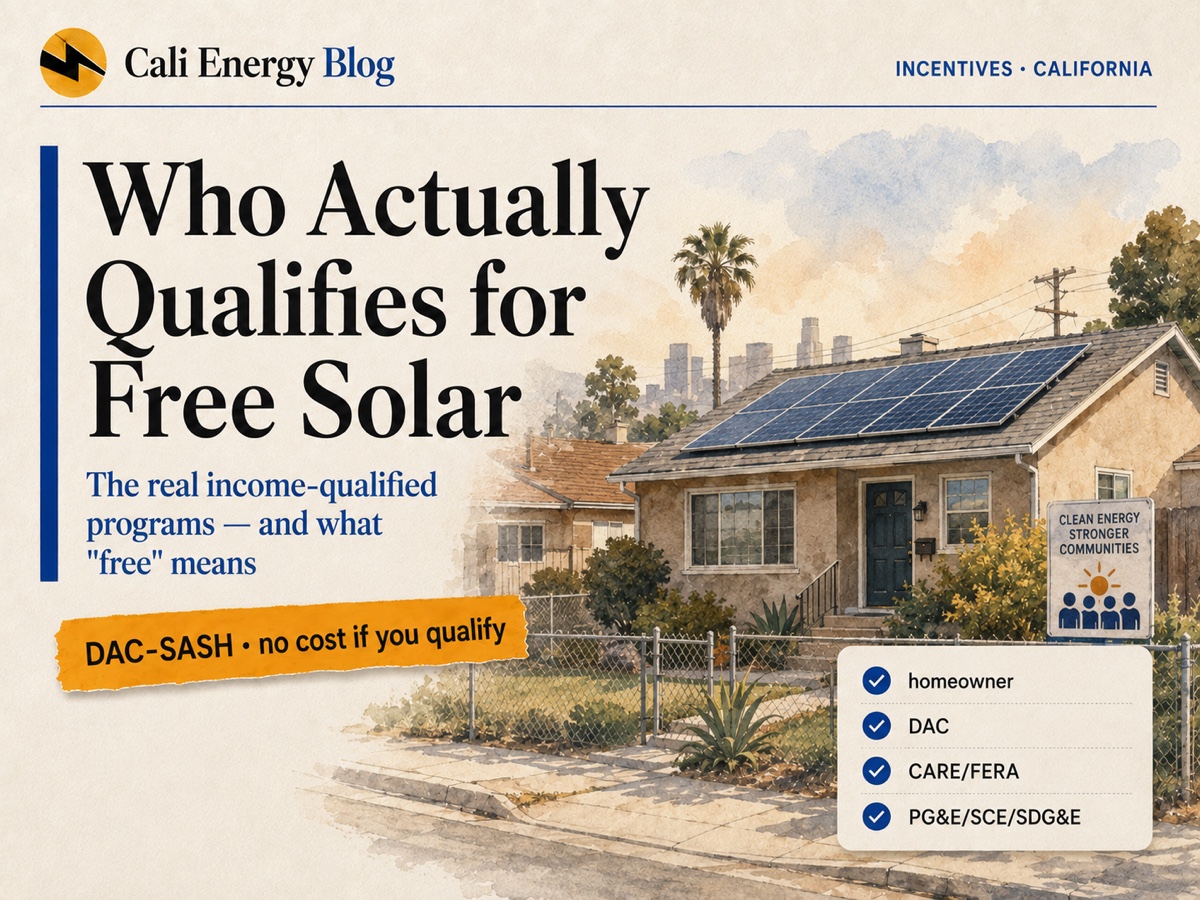
- Genuine no-cost rooftop solar is limited to specific income-qualified, location-qualified, utility or nonprofit programs — it is not generally available to the open market.
- DAC-SASH is the statewide no-cost rooftop program for low-income homeowners in disadvantaged communities served by PG&E, SCE or SDG&E. It is real but small: about 1,400 homes in all of SCE’s territory since 2020, 313 of them in Los Angeles County.
- CARE and FERA are bill discounts, not solar — but their income limits are one of the requirements for the solar programs.
- LADWP homes can’t use DAC-SASH, but LADWP has its own Solar Rooftops program, which installs and owns panels on a home and pays the owner rent, and LADWP customers can apply for income-qualified SGIP battery and solar incentives.
DAC-SASH — no-cost rooftop solar (if you qualify)
DAC-SASH (Disadvantaged Communities – Single-family Affordable Solar Homes), administered by GRID Alternatives, provides no-cost rooftop solar to income-qualified homeowners in disadvantaged communities. It is funded through 2030.
Eligibility requires all of the following — meeting the income limit alone is not enough:
- Electric service from PG&E, SCE, or SDG&E;
- You own and live in a single-family home as your primary residence;
- The address is in a disadvantaged community on the state’s CalEnviroScreen 4.0 map — only the red areas qualify;
- Household income is no higher than the CARE or FERA limits (below).
Apply through GRID Alternatives, by its online eligibility form or toll-free at (866) 921-4696. Important for Los Angeles: DAC-SASH is a CPUC program for the investor-owned utilities, so homes served by LADWP are not covered by it. To check who serves an address, see LA-area electric utilities by city.
Sources: GRID Alternatives — DAC-SASH eligibility · CPUC — Solar in Disadvantaged Communities · verified October 6, 2026.
How many homes actually get it
SCE’s interconnection records, published by the CPUC, flag each DAC-SASH system. Since 2020, SCE has approved:
| Year approved | DAC-SASH systems |
|---|---|
| 2020 | 72 |
| 2021 | 131 |
| 2022 | 174 |
| 2023 | 293 |
| 2024 | 283 |
| 2025 | 246 |
| 2026 (Jan–Aug) | 205 |
| Total | 1,404 |
Of those, 313 are in Los Angeles County — most often in Pomona (35), Compton (31), Long Beach (27), Palmdale (26), Los Angeles addresses served by SCE (22), Norwalk (16) and La Puente (15). The typical system is about 5 kW, and GRID Alternatives installed almost all of them. For scale: SCE approved 35 DAC-SASH systems in Los Angeles County in 2025, out of roughly 16,000 home solar systems there that year. The program works for the households it reaches, but it reaches few.
Source: CPUC California DG Stats, SCE interconnected project sites (interconnection programs “DAC-SASH” and “DAC-SASH-NBT”), data through August 31, 2026 · Cali Energy count.
SASH is closed — DAC-SASH is the successor
The older CSI Single-family Affordable Solar Homes (SASH) Program is closed. If you see references to “SASH,” the active program for qualifying households today is DAC-SASH, above.
Source: CPUC — SASH Program (Closed) · verified October 6, 2026.
SOMAH — solar for multifamily affordable housing
SOMAH (Solar on Multifamily Affordable Housing) pays incentives to put solar, and now energy storage, on deed-restricted multifamily affordable housing, and passes bill credits to the tenants. It is aimed at property owners and residents of qualifying buildings, not single-family homeowners. The program reports 220 applications and more than $38 million in incentives paid in 2025, over 70 applications so far in 2026, and more than 65,000 low-income households expected to benefit from completed and ongoing projects. In SCE’s territory, 473 SOMAH projects have been interconnected since 2021, 47 of them in Los Angeles County.
Sources: SOMAH program · CPUC — Low-Income Solar Programs · CPUC DG Stats (“SOMAH-VNM”) · verified October 6, 2026.
LADWP homes: the Solar Rooftops program
LADWP runs its own version of “free solar,” and it works differently. Under Solar Rooftops, LADWP designs, permits and installs a 1–10 kW system on a qualifying owner-occupied home at no cost, then pays the owner $360–$900 a year for up to 20 years ($7,200–$18,000 in total) for the use of the roof. LADWP owns the system and receives all of the energy, so the panels do not lower the home’s own bill — the benefit is the rent check, paid regardless of how much the system produces.
It is open to LADWP residential customers on rates R-1A, R-1B, R-1D (low-income) or R-1E (Lifeline), not only to income-qualified households, but the home must pass LADWP’s inspection for roof condition and shading. A homeowner who wants panels that cut their own bill under LADWP net metering would need to own the system.
Source: LADWP — Solar Rooftops · verified October 6, 2026.
CARE and FERA — the bill discounts that open the door
These are rate discounts, not solar programs — but meeting CARE or FERA income eligibility is one of the requirements for DAC-SASH; it is not automatic program approval.
- CARE (California Alternate Rates for Energy): a 30–35% discount on the electric bill for households at or below 200% of the Federal Poverty Guidelines.
- FERA: for households just above the CARE limit (up to 250% of the guidelines); an 18% discount on the electric bill at SCE, PG&E and SDG&E, and at SCE a discounted Base Services Charge (about $12/month).
Income limits are set by the CPUC and updated annually. For June 1, 2026 – May 31, 2027:
| Household size | CARE income limit | FERA upper limit |
|---|---|---|
| 1–2 | $43,280 | $54,100 |
| 3 | $54,640 | $68,300 |
| 4 | $66,000 | $82,500 |
| 5 | $77,360 | $96,700 |
LADWP customers have their own income-qualified discounts (EZ-SAVE and Lifeline); see LADWP rates explained.
Sources: CPUC — CARE/FERA income limits · CPUC — FERA · verified October 6, 2026.
Community solar (for renters or roofs that can’t host solar)
If rooftop solar isn’t possible, DAC-GT (Disadvantaged Communities Green Tariff) gives qualifying residential customers in disadvantaged communities utility-scale renewable electricity and a 20% bill discount. Since July 1, 2026 it is funded through the Public Purpose Program surcharge on bills, under AB 1207. The older CSGT community-solar program was largely discontinued, and on June 11, 2026 the CPUC finalized the details of a new Community Renewable Energy program; utilities must have their implementation plans approved before it launches. These are bill benefits, not free rooftop installations.
Sources: CPUC — Community Solar · CPUC — June 11, 2026 community-solar decision · verified October 6, 2026.
Income-qualified battery and solar help (SGIP)
The state’s SGIP Residential Solar and Storage Equity budget pays $1.10 per watt-hour of storage and $3.10 per watt of solar for income-qualified households. Unlike DAC-SASH, it covers LADWP customers too, because LADWP is one of the program’s administrators. As of October 5, 2026, the budgets for SCE ($86.3 million), LADWP ($32.4 million) and the SoCalGas-run budget for Glendale, Burbank, Pasadena and Vernon ($13.5 million) were all on a waitlist; applications and waitlist entries are accepted until June 30, 2028. Details are on our SGIP battery incentives and California solar incentives pages.
Source: SGIP program metrics · checked October 5, 2026.
What about the federal tax credit?
Under current IRS guidance, the federal Residential Clean Energy Credit (§25D) is not allowed for expenditures made after December 31, 2025 (repealed by Public Law 119-21, July 4, 2025). Tax treatment depends on the facts and applicable law; homeowners should confirm eligibility with a qualified tax professional.
Source: IRS Form 5695 instructions · verified October 6, 2026.
The honest version of “free solar”
If an ad promises “free solar panels” to the general public, be skeptical. Real no-cost rooftop solar in California runs through income- and location-qualified programs like DAC-SASH, or utility programs like LADWP’s Solar Rooftops, which pays rent rather than cutting your bill — not the open market. A lease or power-purchase agreement sold as “$0 down” is a payment plan, not free solar; see cash vs loan vs lease. Every program is subject to eligibility, funding availability, and program rules, and funding can close. Check your eligibility directly with the program administrator before relying on any benefit.
Frequently asked
Is there really free solar in California?
Who qualifies for DAC-SASH?
Is there free solar for LADWP customers?
What is the difference between CARE and FERA?
Can renters get help going solar?
Is the federal solar tax credit still available in 2026?
Related reading
Sources & methodology
Figures on this page come from the primary sources below and, where noted, from Cali Energy calculations using the stated assumptions. Rates, incentives, and program terms change; each was verified October 6, 2026.
- GRID Alternatives — DAC-SASH eligibility
- CPUC — Solar in Disadvantaged Communities
- CPUC — California DG Stats, SCE interconnected project sites (data through Aug 31, 2026)
- SOMAH — Solar on Multifamily Affordable Housing
- LADWP — Solar Rooftops program
- CPUC — CARE/FERA income limits (June 2026 – May 2027)
- CPUC — FERA program
- CPUC — Community Solar
- CPUC — June 11, 2026 community solar decision
- CPUC — Low-Income Solar Programs
- SGIP — Program metrics
- IRS — Form 5695 instructions (§25D)
About this guide
This reference is maintained by the Cali Energy research team to help California households find legitimate low-income and no-cost solar options. Program rules, income limits, and funding change — confirm current eligibility directly with the program administrator.
Prepared by Cali Energy, October 6, 2026. This article is for general educational purposes only and is not legal, tax, financial, engineering, or utility advice. Rates, incentives, codes, permit requirements, equipment specifications, prices, and program terms may change; figures and timelines are estimates, not guarantees. Confirm current requirements with the applicable utility, AHJ, program administrator, manufacturer, or a licensed professional. See our Content Disclaimer. Cali Energy · 19201 Parthenia St, Unit E, Northridge, CA 91324 · CSLB #1032379 (B, C-10, C-39)