

NEM 2.0 vs NEM 3.0 in California: What Changed
One thing above all: what your exported solar is worth. Under NEM 2.0 an exported kilowatt-hour is credited at the same price you pay to import one at that hour. Under NEM 3.0 — the Net Billing Tariff, for applications from April 15, 2023 — it earns an avoided-cost value instead: on SCE, about 3¢ to 21¢ for a system starting in 2026. Bills went monthly, and batteries went from optional to standard: in SCE’s part of Los Angeles County, 76% of NEM 3.0 homes have one, against 13.5% on NEM 2.0.
Get a free estimate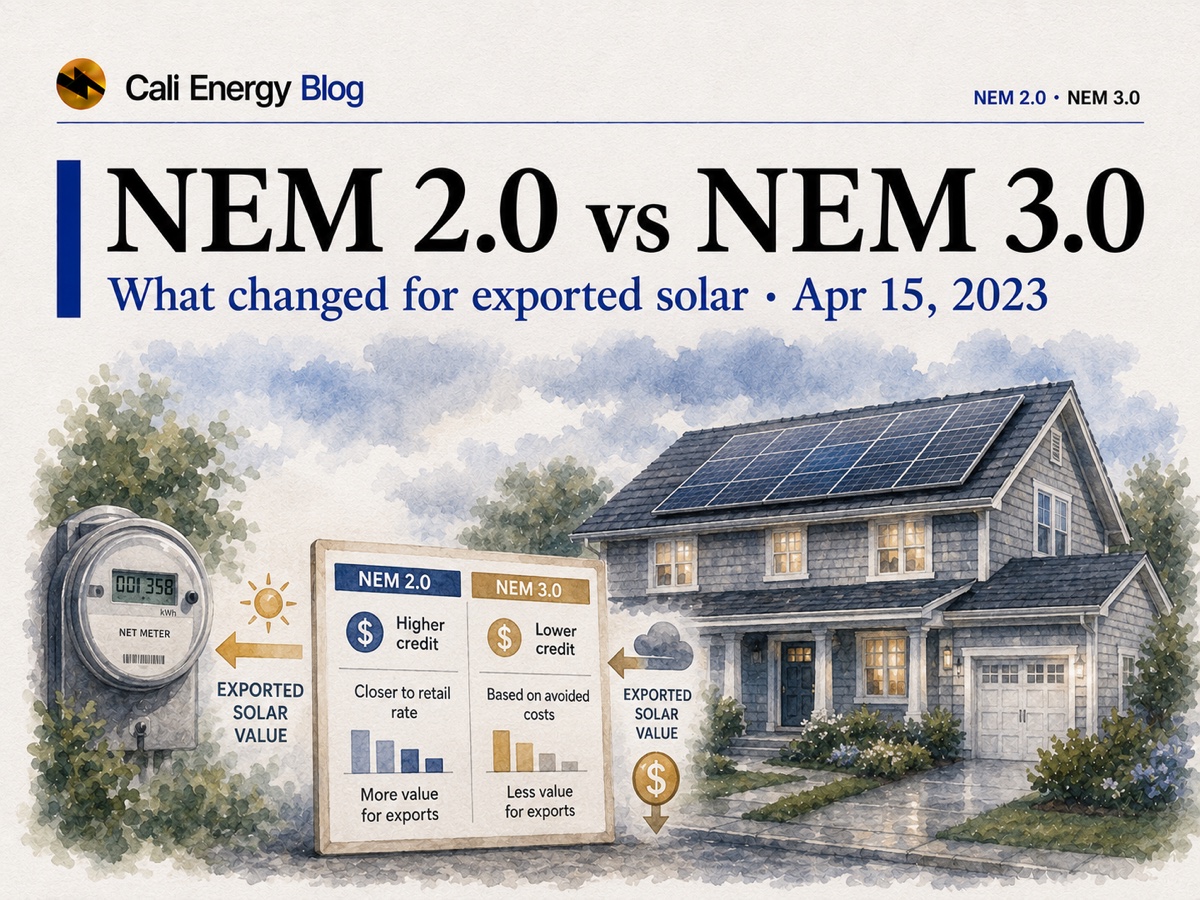
- Export credit: NEM 2.0 credits exports at the import price of that hour; NEM 3.0 at the CPUC’s avoided-cost values — on SCE about 6¢ on a summer day, 21¢ on a summer evening and 3¢ on a winter day for a 2026 start, plus a 1.6¢ bonus.
- Charges and billing: NEM 3.0 bills monthly and applies non-bypassable charges to every kWh imported; NEM 2.0 bills energy yearly and nets those charges hour by hour.
- How long it lasts: NEM 1.0 and 2.0 run 20 years from interconnection; NEM 3.0 export values are locked for 9 years.
- No per-kW solar fee: both pay the same monthly Base Services Charge as other SCE customers.
NEM 1.0, NEM 2.0 and NEM 3.0 side by side
The CPUC publishes its own comparison of the three tariffs used by SCE, PG&E and SDG&E. In plain terms:
| NEM 1.0 | NEM 2.0 | NEM 3.0 (Net Billing Tariff) | |
|---|---|---|---|
| Who | Connected 1996 to the 2016–2017 sunset | Applied from then to April 14, 2023 | Applied from April 15, 2023 |
| Rate plan | Any | Time-of-use | Specific “electrification” time-of-use plans (TOU-D-PRIME on SCE) |
| Credit for exports | Import price | Import price | Avoided-cost values, usually lower |
| Non-bypassable charges | On net use over the year | On net use in each hour | On every kWh imported |
| Billing | Annual | Annual (charges and credits roll 12 months) | Monthly; credits roll to the annual true-up |
| Surplus at true-up | Wholesale price | Wholesale price | Wholesale price |
| Interconnection fee | None | $94–145 (SCE $94) | $94–145 (SCE $94) |
| System size limit | Annual use, up to 1 MW | Annual use | Annual use plus up to 50% with an attestation |
| How long | 20 years from interconnection | 20 years from interconnection | Export values locked 9 years |
Sources: CPUC, Net Energy Metering and Net Billing (comparison table) · CPUC, Net Billing Tariff · SCE Schedule NEM-ST · SCE Solar Billing Plan.
What one exported kilowatt-hour earns on SCE
On NEM 2.0 an export offsets an import at the time-of-use price of that hour; you still pay the non-bypassable charges — public purpose programs, nuclear decommissioning, competition transition and the wildfire fund — on your net use in each hour (NEM-ST).
On SCE’s Solar Billing Plan an export earns an Energy Export Credit by hour and season. For a system that starts in 2026, SCE’s averages are about 6¢ on a summer day, 21¢ on a summer evening and 3¢ on a winter day, locked for nine years, plus an Energy Export Bonus Credit set by start year in Schedule NBT — 4.0¢ for 2023, 1.6¢ for 2026, 0.8¢ for 2027. Power bought between 4 and 9 p.m. on TOU-D-PRIME costs about 61¢ on a summer weekday, which is the whole reason NEM 3.0 systems store midday solar instead of exporting it. See SCE solar billing explained, NEM 3.0 explained and do you need a battery?
Fixed charges are the same on both: SCE’s Base Services Charge applies to all residential customers, NEM 2.0 included, since late 2025. There is no separate per-kilowatt fee for solar.
Who is on which tariff in Los Angeles
| Tariff | Homes | Share | With a battery |
|---|---|---|---|
| NEM 2.0 | 101,704 | 51.6% | 13.5% |
| NEM 1.0 | 56,558 | 28.7% | 0.8% |
| NEM 3.0 | 38,807 | 19.7% | 76.4% |
Source: California DG Stats, Interconnected Project Sites, SCE, data through August 31, 2026; residential sites in Los Angeles County; Cali Energy count. LADWP customers are not in this dataset.
Four in five solar homes in SCE’s part of the county are still on a legacy tariff. None stay there for good: at the end of the true-up year that closes on or after a system’s 20th anniversary, it moves to the Net Billing Tariff. See NEM 2.0 grandfathering.
The key dates
| Date | What happened |
|---|---|
| Dec 15, 2022 | CPUC adopts the Net Billing Tariff (Decision D.22-12-056) |
| Apr 14, 2023 | Last day to submit a complete NEM 2.0 application |
| Apr 15, 2023 | New applications go on the Net Billing Tariff |
| Nov 30, 2023 | CPUC approves the utilities’ tariffs (Resolution E-5301) |
| Aug 7, 2025 | California Supreme Court orders courts to review the decision independently and sends it back |
| Mar 9, 2026 | Court of Appeal upholds the Net Billing Tariff again |
| Apr 14, 2026 | Deadline for NEM 2.0 applications filed before the cutoff to finish: signed agreement and final building sign-off |
Sources: CPUC · SCE NEM-ST · S283614 · A167721.
What changed in the market
Statewide, home solar connected by the three big utilities peaked at 271,223 systems in 2023, the rush to beat the deadline, and fell to 145,370 in 2025. The share of new systems with a battery rose from 7% in 2022 to 61% in 2025, and leases and PPAs grew from 25% to 45% of the market. See what NEM 3.0 did to California solar.
What it means for you
Check your bill
The tariff is printed on it: NEM, NEM-ST (2.0) or Solar Billing Plan / NBT. Your PTO letter shows when the 20 years started.
On NEM 2.0: protect it
Repairs keep the tariff, and a battery generally does too — but SCE counts added storage against its 10%-or-1 kW expansion limit, so confirm before you add one. Growing the solar past that limit does not. See adding panels and adding a battery.
On NEM 3.0: use it on site
Midday exports earn a few cents; covering the 4–9 p.m. window with stored solar is where the savings are. See SCE time-of-use plans.
On LADWP: neither
LADWP is a city utility with its own net metering that nets exports at retail. See LADWP solar and battery incentives.
Where to go next
Cali Energy designs solar and batteries in Los Angeles around the tariff you are actually on. Call +1-323-844-7777 or ask for a review of your bill — savings figures are estimates, not guarantees.
Frequently asked
What is the difference between NEM 2.0 and NEM 3.0?
Mainly the export credit. NEM 2.0 credits exported solar at the import price of that hour; NEM 3.0 (the Net Billing Tariff) credits it at avoided-cost values, on SCE about 3–21¢ for a 2026 start. NEM 3.0 also bills monthly and applies non-bypassable charges to every kWh imported.
When did NEM 3.0 take effect?
For interconnection applications submitted on or after April 15, 2023 at SCE, PG&E and SDG&E. The CPUC adopted it on December 15, 2022.
How do I know which tariff I’m on?
Look at your bill: NEM or NEM-ST (2.0) on legacy plans, Solar Billing Plan or NBT on NEM 3.0. As a rule, a complete application submitted by April 14, 2023 is on NEM 2.0.
How long does NEM 2.0 last?
Twenty years from interconnection, through the true-up year that closes on or after the 20th anniversary. Then the system moves to the Net Billing Tariff.
What is the difference between NEM 1.0 and NEM 2.0?
NEM 2.0 added a time-of-use rate requirement, an interconnection fee ($94 on SCE) and non-bypassable charges on net use in each hour; NEM 1.0 netted those charges over the whole year. Both credit exports at the import price.
Is there a monthly fee per kW of solar under NEM 3.0?
No. The CPUC’s comparison of the tariffs lists no per-kW charge for solar, and SCE solar customers pay the same Base Services Charge as other residential customers.
Does NEM 3.0 apply to LADWP?
No. LADWP runs its own net metering, which nets exports against imports at the retail price.
Related reading
Sources & methodology
Figures on this page come from the primary sources below and, where noted, from Cali Energy calculations using the stated assumptions. Rates, incentives, and program terms change; each was verified October 5, 2026.
- CPUC — Net Energy Metering and Net Billing (comparison of NEM 1.0, NEM 2.0 and NBT)
- CPUC — Net Billing Tariff (D.22-12-056, December 15, 2022; applies from April 15, 2023)
- SCE — Schedule NEM-ST (closed April 15, 2023; non-bypassable charges; three-year completion deadline)
- SCE — How the Solar Billing Plan works (export values by start year)
- SCE — Schedule NBT (Energy Export Bonus Credit by vintage)
- SCE — Base Services Charge
- California DG Stats — Interconnected Project Sites (SCE, data through August 31, 2026; Cali Energy count)
- Supreme Court of California — Center for Biological Diversity v. PUC, S283614 (August 7, 2025)
- California Court of Appeal — Center for Biological Diversity v. PUC, A167721 (March 9, 2026)
- LADWP — Service Rider NEM, Net Energy Metering
- SCE — Net Energy Metering FAQ (expansion limits also apply to added storage; “NEM 1.0/2.0 Expansion” application)
Design for the tariff you’re actually on
Whether you are protecting NEM 2.0 or making the most of NEM 3.0, get a solar and storage plan built for your tariff. Estimates, not guarantees.
Get a free estimatePrepared by Cali Energy, October 5, 2026. This article is for general educational purposes only and is not legal, tax, financial, engineering, or utility advice. Rates, incentives, codes, permit requirements, equipment specifications, prices, and program terms may change; figures and timelines are estimates, not guarantees. Confirm current requirements with the applicable utility, AHJ, program administrator, manufacturer, or a licensed professional. See our Content Disclaimer. Cali Energy · 19201 Parthenia St, Unit E, Northridge, CA 91324 · CSLB #1032379 (B, C-10, C-39)