

Solar Financing & Payback in Los Angeles (2026)
Short version: there are three ways to pay for solar — cash, a solar loan, or a lease/PPA — and they differ mostly in who owns the system and who gets the tax benefit. Payback (the point where savings have covered your cost) usually runs roughly 7–12 years in illustrative Los Angeles scenarios, and it's faster on LADWP than on SCE because the export and rate rules differ. Here's the plain-English framework.
Get a free estimate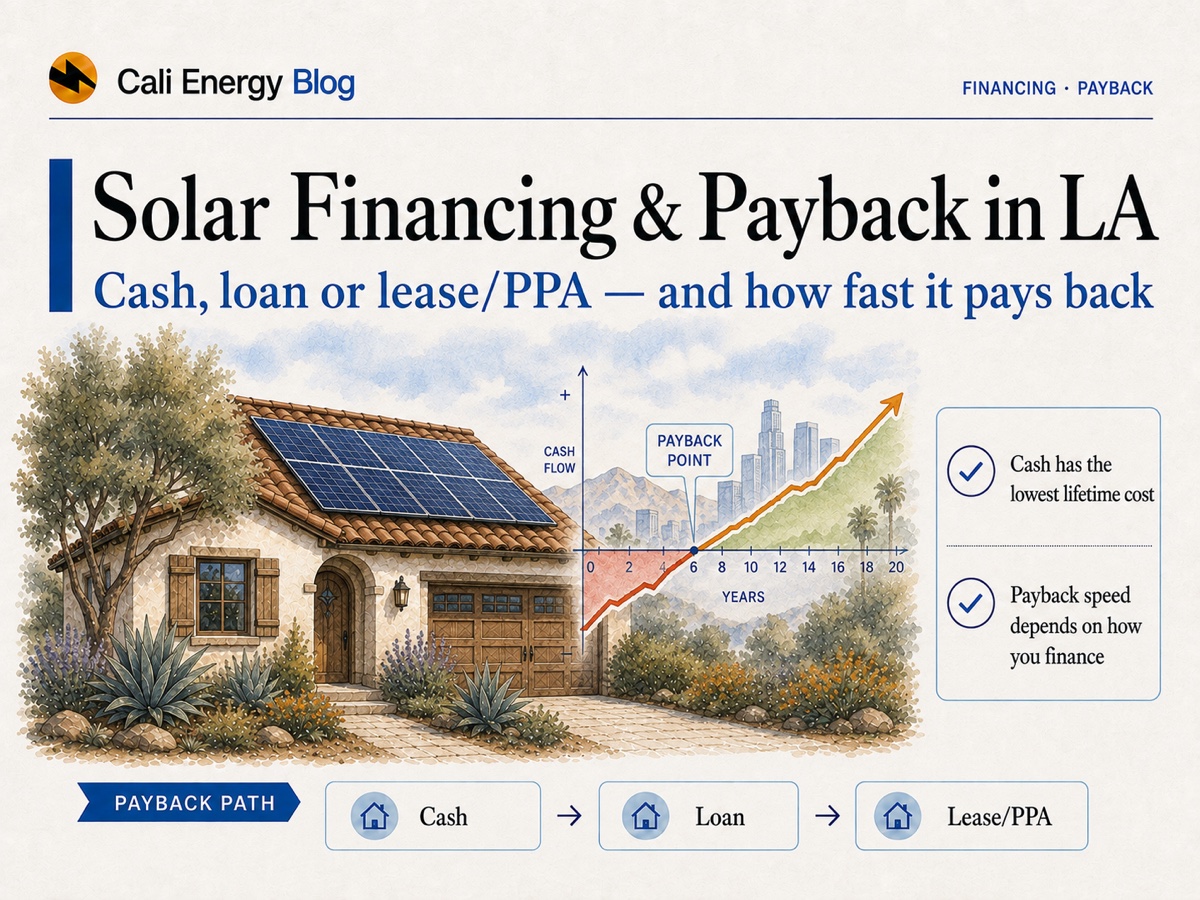
- Three ways to pay: cash (you own it), a solar loan (you own it, financed), or a lease/PPA (a third party owns it and you pay for the power).
- The 30% federal tax credit ended Dec 31, 2025 for owner-bought (cash/loan) systems. With a lease/PPA the third-party owner may claim a separate business credit — you don't.
- Payback is illustrative, not a guarantee: it's usually faster on LADWP (more retail-like net metering) than on SCE (NEM 3.0 rewards using your own solar and pairs well with a battery).
The three ways to pay for solar
Almost every residential solar deal in Los Angeles is one of three structures. They're not really about interest rates first — they're about who owns the panels, which decides who gets any tax benefit and who's responsible for the equipment. Here's the overview; for a side-by-side breakdown of the trade-offs, see our cash vs. loan vs. lease/PPA comparison.
| Path | Upfront cost | Who owns it | Payback feel | When it tends to make sense |
|---|---|---|---|---|
| Cash | Full system price | You | Best lifetime savings; you carry the whole cost until it pays back | You have the funds and want the lowest long-run cost of energy |
| Solar loan | Little or none down | You (financed) | Monthly payment instead of a bill; interest & any dealer fee stretch payback | You want to own the system but keep your cash |
| Lease / PPA | Usually $0 down | A third party | No payback in the ownership sense — you're buying power, not an asset | You want lower upfront cost and prefer the provider to own the system and carry defined maintenance (savings depend on the contract) |
Framework based on EnergySage — how to pay for solar and SolarReviews. A higher price for any path can be justified by roof work, electrical upgrades, or premium equipment.
What changed in 2026 — and why ownership matters more now
Through 2025, a homeowner who bought a system with cash or a loan could claim the 30% federal Residential Clean Energy Credit. That credit ended for owner-bought systems placed in service after December 31, 2025 — there's no phase-down and no transition rule, so for a 2026 cash or loan system the federal credit is 0%. We cover the details in what the end of the 30% credit means.
With a lease or PPA, the third-party company owns the equipment, so it — not you — may claim a separate business tax credit, and it typically prices that benefit into your rate. You never file for it yourself. That's the real reason ownership matters in 2026: it decides who captures any remaining federal incentive.
A loan payment isn't automatically "free" solar
Zero-down financing replaces a utility bill with a loan payment. That can still come out ahead, but interest and, in some financing examples we've reviewed, a dealer fee (sometimes roughly 15–30% of the system price) raise the amount you ultimately repay and push out payback. It's worth an itemized explanation of the cash price versus the financed price before you sign.
What "payback" actually means
Payback is simply the point where your accumulated savings have covered what you paid. If a system costs $18,000 net and saves about $2,000 a year, payback is roughly nine years — and everything after that is savings over the system's 25-year-plus life. It only applies when you own the system (cash or loan); with a lease/PPA there's no asset to pay back, just a lower monthly cost for power.
Two things move payback the most: how much your electricity costs and how much value you get for the solar you produce. That's exactly where LADWP and SCE part ways, so a single "average" payback number for "Los Angeles" is misleading. Below is an illustrative comparison; to run your own inputs, use our solar payback calculator.
| Scenario | Net system cost | Illustrative annual savings | Illustrative payback |
|---|---|---|---|
| LADWP home, solar-only | ~$18,000 | ~$2,200 | ~8 yrs |
| SCE home, solar-only (NEM 3.0) | ~$18,000 | ~$1,700 | ~10–11 yrs |
| SCE home, solar + battery (NEM 3.0) | ~$28,000 | ~$2,500 | ~11–12 yrs |
Assumptions: owner-bought (no lease/PPA), no federal tax credit in 2026, ~$2.60–$3.50/W installed before extras, and Los Angeles production of roughly 1,585 kWh per kW-year. Savings scale with your actual usage and rate plan. Sources: EnergySage — LADWP net metering · CPUC Net Billing Tariff.
Why LADWP and SCE paybacks differ
Same panels, same sun — different rulebooks. It comes down to how each utility credits the solar you send back to the grid.
LADWP: more retail-like net metering
LADWP is a municipal utility, so it isn't under NEM 3.0. Exports are credited close to the retail rate, which keeps solar-only paybacks relatively short and makes a battery optional rather than essential for economics.
SCE: NEM 3.0 (Net Billing Tariff)
On SCE, exported solar earns a time-varying credit that's usually far below retail — an illustrative 5–8¢/kWh at common midday hours, with a few late-summer evening hours worth much more. That rewards using your own solar rather than exporting it.
Why batteries fit SCE
Because midday exports are worth little on NEM 3.0, storing that energy and using it in the pricey evening peak captures more value. A battery raises upfront cost but lifts SCE savings — see NEM 3.0 explained.
Your rate is the other half
The more you pay per kWh, the faster solar pays back. Los Angeles rates and plans vary by utility and tier — check Los Angeles electricity rates before assuming a payback number.
A simple way to choose
You don't need a spreadsheet to narrow it down. Start with two questions: do you want to own the system, and do you want to put money down?
Want the lowest lifetime cost and have the funds? Cash wins on total savings — you skip interest and fees entirely. Want to own it but keep your cash? A loan does that; just compare the cash price to the financed price and ask for the dealer fee in writing. Don't want ownership, maintenance, or tax paperwork? A lease or PPA can cut upfront cost to as little as $0 down, at the cost of the best long-run savings and any resale simplicity — and the actual savings, escalator and buyout terms depend on the contract. None of these is universally "best" — it depends on your goals, and whether you're on LADWP or SCE.
Whichever path you pick, the payback math only holds if the system is sized and priced honestly for your roof. For that, compare itemized quotes rather than headline monthly numbers — our checklist for comparing solar quotes shows what to line up. And if you're weighing whether to go solar at all this year, start with is solar still worth it in California?
Read the contract, and know your right to cancel
Whatever you sign — cash, loan, lease, or PPA — California gives you a right to cancel, generally at least 3 business days (5 business days if you're 65 or older); the terms can vary depending on where and how you signed. A transparent provider will hand you an itemized price and explain any financing fee without pressure. See the CPUC California Solar Consumer Protection Guide for your full rights.
Bottom line
In 2026 Los Angeles, choosing how to pay for solar is really choosing whether to own the system — and owning it is what captures the long-run savings, even without the federal credit. Payback is a useful yardstick, not a promise: expect it faster on LADWP and a bit longer on SCE, where a battery often earns its keep. Run your own numbers with the payback calculator, and get an itemized quote before you commit.
Frequently asked
What are the ways to pay for solar in Los Angeles?
Three: cash (you own the system outright), a solar loan (you own it but finance it, often with little or nothing down), or a lease/PPA (a third party owns the panels and you pay a lower rate for the power). The main difference is who owns the system and who gets any tax benefit. For a full side-by-side, see our cash vs. loan vs. lease/PPA comparison.
How long is the payback on solar in Los Angeles?
For an owned system, illustrative paybacks usually land around 7–12 years — typically faster on LADWP (more retail-like net metering) and a bit longer on SCE (NEM 3.0). These are illustrative scenarios, not guarantees. Your actual payback depends on the system price per watt, annual production and usage, your utility rate and any escalation, panel degradation, whether a battery is included, and how it is financed. As a concrete basis, these ranges assume an owner-bought system at roughly $2.60–$3.50/W, about 1,400–1,700 kWh per year per installed kW, no battery, and current utility rates — run your own inputs in the payback calculator.
Is there still a federal tax credit in 2026?
Not for owner-bought systems. The 30% federal Residential Clean Energy Credit ended December 31, 2025 for cash and loan systems — there's no phase-down, so it's 0% in 2026. With a lease or PPA, the third-party owner may claim a separate business credit and price it into your rate; you don't file for it. More in the 30% credit ended.
Why does payback differ between LADWP and SCE?
Because the export rules differ. LADWP’s municipal rules (it’s not under NEM 3.0) generally treat exports more favorably than SCE’s Net Billing Tariff, which can improve solar-only economics; the actual payback depends on the applicable rate schedule, usage profile and system design. SCE uses NEM 3.0, where exported solar earns a time-varying credit usually far below retail (an illustrative 5–8¢/kWh at common midday hours). That rewards self-consumption and makes a battery more valuable. See NEM 3.0 explained.
Is a $0-down solar loan really cheaper than my bill?
Sometimes, but not automatically. A zero-down loan swaps your utility bill for a loan payment, and interest — plus, in some financing examples we've reviewed, a dealer fee of roughly 15–30% of the system price — raises the total you repay and lengthens payback. Ask for the cash price and the financed price side by side, itemized, before signing.
Which financing path is best?
There's no universal best. Cash gives the lowest lifetime cost if you have the funds; a loan lets you own the system while keeping your cash; a lease/PPA can reduce upfront cost and generally puts system ownership and defined maintenance on the provider — but savings, escalators, service obligations and buyout terms all depend on the contract, and it gives up the best long-run savings. Start by deciding whether you want to own the system, then compare itemized quotes using our quote checklist.
Related reading
Not sure whether to pay cash, finance, or lease?
Tell us your utility (LADWP or SCE) and a recent bill, and we'll show you the numbers for each path — itemized, no dealer-fee surprises, no pressure. Call +1-323-844-7777.
Get a free estimatePrepared by Cali Energy, August 2026. This article is for general educational purposes only and is not legal, tax, financial, engineering, or utility advice. Rates, incentives, codes, permit requirements, equipment specifications, prices, and program terms may change; figures and timelines are estimates, not guarantees. Confirm current requirements with the applicable utility, AHJ, program administrator, manufacturer, or a licensed professional. See our Content Disclaimer. Cali Energy · 19201 Parthenia St Unit E, Northridge, CA 91324 · CSLB #1032379 (B, C-10, C-39)