

Why Did My Electric Bill Go Up After Solar?
Short answer: a higher bill after solar usually doesn’t mean your system is broken. The most common causes are normal billing mechanics — a once-a-year true-up on older net-metering plans (NEM 3.0 bills monthly), fixed charges solar can’t erase, and rate-plan changes. Below, a plain table sorting the normal reasons from the few that are worth a call to your installer.
Get a free estimate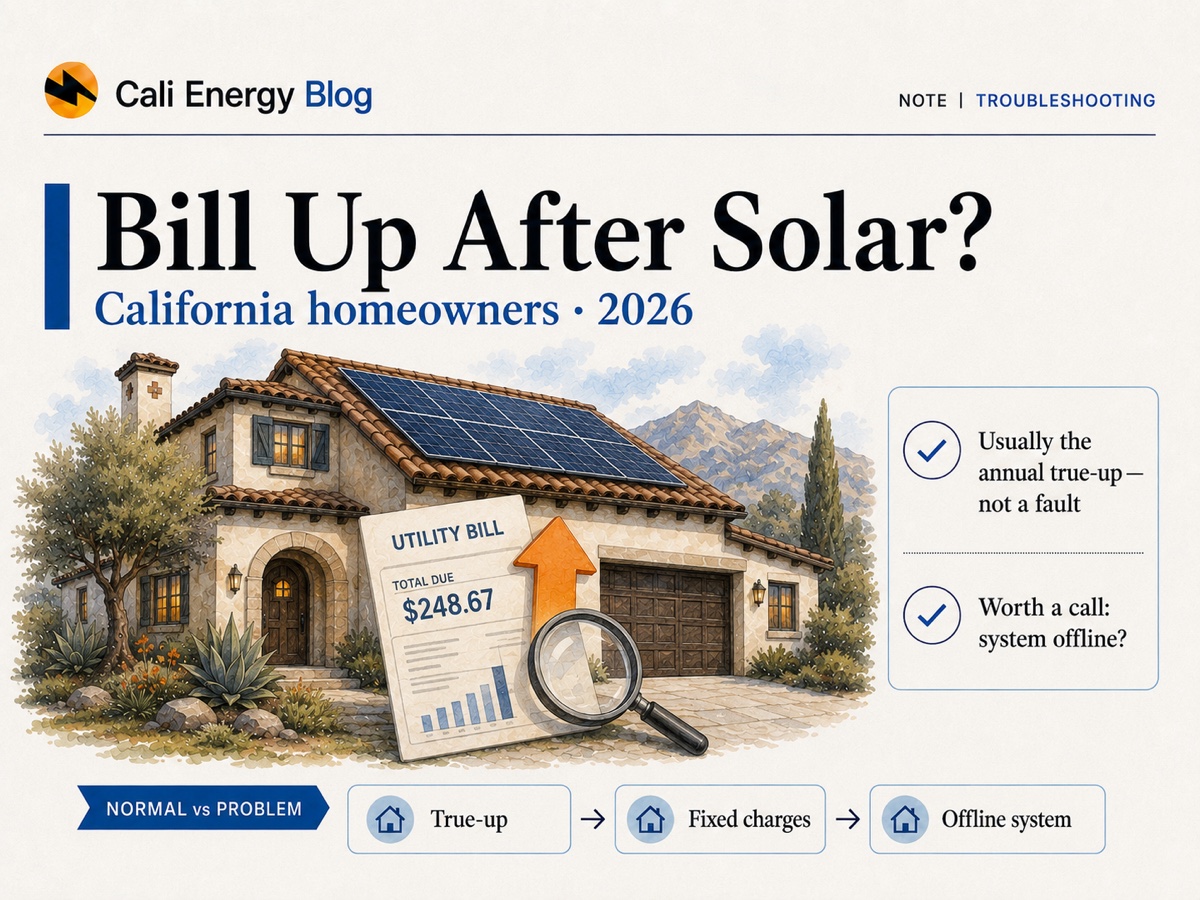
- A higher bill after solar usually means a true-up settlement, a fixed charge, or a rate-plan change — not a broken system.
- Solar can’t erase non-bypassable charges or the monthly base service charge (about $24 on SCE (less for CARE/FERA)), so a small bill is normal even in a great month.
- If production has clearly dropped — shading, an inverter fault, or an offline system — that’s the one worth a call to your installer.
The short answer
Most “my bill went up after solar” surprises trace back to a handful of normal causes: the once-a-year true-up, fixed charges solar was never meant to cover, a change in your rate plan, or simply using more power than the system was sized for. A smaller group of causes — shading, a fault, or an offline inverter — are real problems. The two tables below sort them out.
Usually expected — this is normal
These show up on almost every solar bill and don’t mean anything is wrong. They’re how the utility bills a solar home, not a defect.
| Cause | What’s happening | What to do |
|---|---|---|
| Annual true-up settlement | On net metering (NEM 1.0/2.0) your utility reconciles a full year of charges and credits at once, so one true-up bill can cover 12 months. On the newer Net Billing Tariff (NEM 3.0) you’re billed monthly and mainly your credits settle at the annual true-up. | Compare the true-up to a whole year, not one month. Expect a modest balance even with good production. |
| Non-bypassable charges | A few cents per kWh (about 4¢ in SCE’s July 2026 sample bill) of public-program and wildfire-fund fees that export credits can’t offset — you pay them on every kWh you import. | Nothing to fix; budget a small standing charge. More self-consumption (or a battery) reduces imports. |
| Monthly base service charge | SCE added a fixed Base Services Charge (about $24/month for standard residential; roughly $12 for FERA and $6 for CARE) in late 2025; PG&E and SDG&E structure their own fixed charges differently. | Expect it every month regardless of production. It replaced part of the per-kWh rate. |
| Moved onto a time-of-use plan | Going solar usually puts you on a TOU plan, where power costs far more in the evening than midday. | Learn your plan’s peak window. See SCE TOU plans compared. |
| Heavy use during 4–9 p.m. peak | On SCE, on-peak power can hit roughly 59¢/kWh in summer — after sunset, your panels aren’t producing to offset it. | Shift laundry, EV charging, pool pump and pre-cooling to before 4 p.m. or after 9 p.m. |
| Your usage went up | A new EV, AC unit, pool pump, hot tub, or appliances can add more load than the system was sized for. | Compare kWh used this year vs last. If load grew, you may need more panels or a battery. |
| Low NEM 3.0 export credit (SCE) | Under NEM 3.0, exports on SCE/PG&E/SDG&E are credited at a time-varying rate from the state’s avoided-cost calculator — usually far below the ~35¢ retail you pay (an illustrative 5–8¢/kWh at common midday hours, though a few late-summer evening hours are worth much more), so exporting no longer offsets evening imports the way it once did. | Self-consume midday power; a battery stores it for the peak. Read NEM 3.0 explained. |
| Normal panel degradation | Panels lose roughly 0.5% output per year — real, but gradual, not a sudden jump. | No action for a small yearly drop. A sharp drop is a red flag — see the next table. |
Sources: CPUC — Net Energy Metering & Net Billing · SCE Base Services Charge · SCE — Understanding Your NEM Bill
Your annual true-up is not a monthly bill
With net metering you get a small “statement” most months, then a single true-up once a year that settles 12 months of imports against your credits. If you overproduced in summer and leaned on the grid in winter, the true-up can look alarming — but it covers a whole year. Divide it by 12 before you panic, and compare that to your old monthly bill.
Worth investigating — this may be a problem
These point to lost production or a billing error. If you see them, gather your monitoring data and call your installer.
| Cause | What’s happening | What to do |
|---|---|---|
| Undersized system | The array was designed to offset only part of your usage, so you still buy a lot from the grid. | Check your original proposal’s offset %. Ask about adding panels or a battery. |
| Shading or soiling | New tree growth, a new structure, dust, or heavy soot/pollen can quietly cut output. | Compare this season to last in your app. Trim shade; rinse panels; ask for a production review. |
| Inverter fault or system offline | A tripped inverter, lost Wi-Fi, or an outage can stop production — sometimes for weeks — while you keep buying full-price power. | Check the monitoring app today. Red/error status or long flat lines = call your installer now. |
| Billing lag or estimated read | A delayed interconnection, a mis-applied rate, or an estimated (not actual) meter read can inflate a bill. | Confirm the meter read is “actual,” and that solar/TOU rates are applied. Call the utility to correct it. |
How to diagnose your own bill in 5 minutes
1. Open your monitoring app
Is the system producing today? A flat line or error means it’s offline — the single most common real problem.
2. Read the whole year
If it’s a true-up, look at 12 months of net usage, not one bill. Divide by 12 to compare fairly.
3. Check your rate plan
Confirm you’re on the right solar/TOU plan and know your peak window. See LA electricity rates.
4. Compare kWh, not dollars
Rates rose statewide. If your kWh used is flat but the bill rose, it’s the rate, not your panels.
5. Look for new loads
New EV, AC, or pool? Real added usage the system wasn’t sized for — see average CA bills.
6. Check for peak-hour use
Running big loads 4–9 p.m. is expensive on TOU. Shift what you can to midday or late night.
Why rates going up isn’t your solar’s fault
California electricity rates have climbed hard — SCE’s average residential rate jumped from roughly 31¢ to about 35¢/kWh in a single 2025 step. That means your old bill would be higher today too, solar or not. Solar shields you from part of that rise, but it can’t stop the base service charge, non-bypassable charges, or the higher price of the grid power you still use in the evening. Compare kWh drawn from the grid year over year — that’s the fair test of whether your system is doing its job.
If your production genuinely dropped, that’s different, and it’s worth a call. A licensed installer can pull your monitoring history, check the inverter, and confirm whether the array is under-producing or you’ve simply outgrown it.
Not sure if it’s normal or a fault?
Send us a recent bill and a screenshot of your solar app. We’ll tell you honestly whether it’s a true-up, a rate change, or a system that needs service — and we won’t upsell you a battery you don’t need. Cali Energy is a licensed California solar contractor (CSLB #1032379).
Get a free bill reviewFrequently asked
Is it normal for my electric bill to go up after getting solar?
Often, yes. The most common causes are completely normal: a once-a-year true-up on net-metering plans (NEM 3.0 bills monthly), the fixed Base Services Charge (about $24/month on SCE; less for CARE/FERA), non-bypassable charges solar can’t offset, being moved onto a time-of-use plan, or simply using more power than your system was sized for. A genuine drop in production — from shading or an offline inverter — is the exception, and that one is worth a call to your installer.
What is a solar true-up bill and why is it so high?
A true-up is an annual reconciliation, but what it covers depends on your tariff. Under older net-metering plans it may settle a year of accumulated energy charges and credits; under NEM 3.0, customers generally pay charges monthly while certain credits are reconciled annually. Because it can cover a whole year at once, the number looks large next to a normal monthly bill. Divide it by 12 to compare fairly. If you overproduced in summer but drew from the grid on winter evenings, a modest true-up balance is expected — even with a well-sized system.
Why do I still get a bill every month if I have solar?
Two charges solar can’t erase. First, the base service charge — a fixed monthly fee (about $24 on SCE; less for CARE/FERA) that your utility bills regardless of production. Second, non-bypassable charges of a few cents per kWh you import (about 4¢ in the July 2026 SCE sample bill), which fund public programs and the state wildfire fund. Even in a strong solar month, expect a small standing bill.
Does NEM 3.0 make my bill higher on SCE?
It can feel that way. Under NEM 3.0 (the Net Billing Tariff on SCE, PG&E and SDG&E), the power you export earns a time-varying credit — usually far below the ~35¢ retail rate you pay to buy it back at night (an illustrative 5–8¢/kWh at midday, though a few late-summer evenings are worth more). So exporting midday and importing in the evening no longer balances out the way it did under NEM 2.0. The fix is to self-consume your solar — a battery stores midday production for the 4–9 p.m. peak. See NEM 3.0 explained.
How do I tell if my solar system is actually broken?
Open your monitoring app first. If today shows a flat line, a red/error status, or weeks of zero production, the system is likely offline or faulted — call your installer. If it’s producing normally but the bill still rose, compare kWh drawn from the grid this year vs last: flat kWh with a higher bill points to rate increases or the true-up, not a fault. A sharp, sudden production drop (not a slow yearly decline) also warrants a service check.
My bill went up but my panels look fine — what changed?
Usually one of three things: California rates rose (SCE’s average jumped from ~31¢ to ~35¢/kWh in 2025), you added a new load like an EV or AC, or you’re running big appliances during the 4–9 p.m. peak when power is most expensive and your panels have stopped producing. Shifting laundry, EV charging and pool pumps to before 4 p.m. or after 9 p.m. often brings the bill back down.
Related reading
Bill went up? Let us read it before you worry
Send us a recent bill and a screenshot of your solar app. We’ll tell you honestly whether it’s a true-up, a rate change, or a system that needs service — no pressure, no upsell.
Get a free estimatePrepared by Cali Energy, August 2026. This article is for general educational purposes only and is not legal, tax, financial, engineering, or utility advice. Rates, incentives, codes, permit requirements, equipment specifications, prices, and program terms may change; figures and timelines are estimates, not guarantees. Confirm current requirements with the applicable utility, AHJ, program administrator, manufacturer, or a licensed professional. See our Content Disclaimer. Cali Energy · 19201 Parthenia St Unit E, Northridge, CA 91324 · CSLB #1032379 (B, C-10, C-39)