

What Is Net Metering and How Does It Work?
Net metering lets the solar you send to the grid reduce the electricity you are billed for: in the EIA’s words, it reduces “the volume of billed electricity supplied by the grid within a defined billing period.” What a sent-out kilowatt-hour is worth depends on the tariff. On LADWP, it cancels a kWh you buy at the same retail price. On SCE’s NEM 2.0, it earns the price of the hour you sent it. On SCE’s Solar Billing Plan (NEM 3.0), which is net billing, it earns a separate, usually much lower export value.
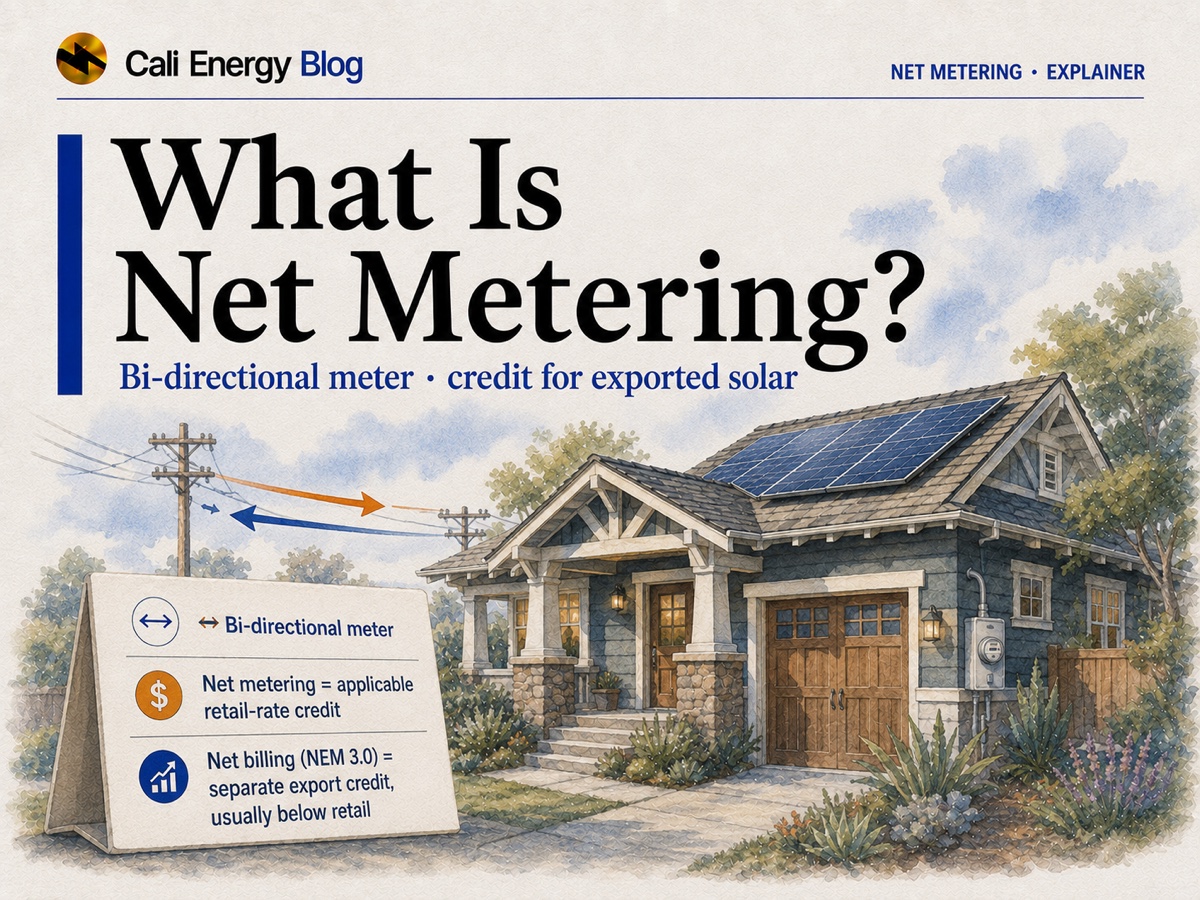
- Net metering: exports are netted against imports, kWh for kWh or at the import price, over a billing period; a meter that runs both ways records each.
- Net billing: imports and exports are priced separately; California’s big utilities switched new customers to it from April 15, 2023.
- LADWP still nets at retail; the credit pays energy charges but not the fixed Power Access Charge or taxes on its standard rate.
- Leftover credit at the yearly true-up earns a wholesale price on SCE; on LADWP it carries forward but is never paid out.
How it works
1. The meter counts both ways. A net or bi-directional meter records what you take from the grid and what your system sends back. 2. Netting. Over the billing period — or each hour, depending on the tariff — exports are set against imports. 3. Credits roll forward. A month with more exports than imports leaves a credit for the next month. 4. True-up. Once a year the account is settled; on California’s investor-owned utilities any surplus is paid at a wholesale price (CPUC). Availability and rules differ by state and utility (DOE).
California’s three tariffs
| NEM 1.0 | NEM 2.0 | Net Billing (NEM 3.0) | |
|---|---|---|---|
| Export credit | Import price | Import price of that hour | Avoided-cost values, usually lower |
| Non-bypassable charges | On net use over the year | On net use each hour | On every kWh imported |
| Billing | Annual | Annual | Monthly, settled yearly |
| Surplus at true-up | Wholesale price | Wholesale price | Wholesale price |
| Who | Connected through 2016–2017 | Applied through April 14, 2023 | Applied from April 15, 2023 |
Source: CPUC, Net Energy Metering and Net Billing. The full comparison is in NEM 2.0 vs NEM 3.0.
One kilowatt-hour, three ways
Take one kWh your panels send out at noon on a summer weekday, and one kWh you buy at 7 p.m.:
| Tariff | Export earns | Purchase costs | You pay the gap |
|---|---|---|---|
| LADWP net metering, R-1A | Same retail price | Same retail price | ~0 |
| SCE NEM 2.0, TOU-D-4-9PM | ~34¢ | ~58¢ | ~24¢ |
| SCE Solar Billing Plan, TOU-D-PRIME | ~7.6¢ | ~61¢ | ~53¢ |
Sources: LADWP NEM rider · SCE time-of-use plans · SCE Solar Billing Plan (6¢ summer-day export value plus 1.6¢ bonus for a 2026 start). Rates as worked out in our SCE billing and LADWP net metering guides; non-bypassable charges and taxes not shown.
The table is the whole story of why batteries spread under NEM 3.0: storing the noon kWh for the evening is worth about 53¢ on SCE’s new plan and almost nothing on LADWP. See do you need a battery?
Net metering on LADWP
LADWP, a city utility, is not on the state’s Net Billing Tariff. Under its NEM rider exports are netted against purchases at the full retail price each billing period, and a surplus becomes a dollar credit that never expires but is never paid out. What the credit covers depends on the rate: on the standard R-1A it pays energy charges above the minimum bill, not the Power Access Charge or taxes; on the time-of-use R-1B it also covers the $12 monthly charge. LADWP allows leased systems but not PPAs. See LADWP net metering in 2026.
Who is on what in Los Angeles
In SCE’s part of Los Angeles County, CPUC records show 51.6% of residential solar systems on NEM 2.0, 28.7% on NEM 1.0 and 19.7% on the Net Billing Tariff. Legacy systems keep their tariff for 20 years from interconnection; see NEM 2.0 grandfathering. To see which one you are on, check the bill; see how to read your electric bill.
Glossary
Net metering
Exports reduce the billed volume of grid electricity within a billing period (EIA).
Net billing
Imports billed at retail, exports credited at a separate value; California’s NEM 3.0.
True-up
The yearly settlement of charges and credits.
Net surplus compensation
Payment for more energy exported than used over the year, at a wholesale price.
Where to go next
For export values hour by hour, see NEM 3.0 export credits explained; for how timing changes with roof direction, which way solar panels should face.
Frequently asked
What is net metering in simple terms?
A billing rule that lets the electricity your solar sends to the grid cancel out electricity you buy, so you pay for the net amount over the billing period.
How does net metering work?
A meter records imports and exports; exports are netted against imports each billing period or hour; surplus credit rolls forward; once a year the account is trued up.
Is net metering a 1:1 exchange?
On LADWP, essentially yes: an exported kWh offsets a purchased kWh at the retail price. On SCE’s NEM 2.0 it is worth the price of the hour it was exported, and on the Solar Billing Plan far less.
What’s the difference between net metering and net billing?
Net metering nets exports against imports at retail-based prices. Net billing prices them separately: imports at retail, exports at an avoided-cost value. A summer noon export earns about 7.6¢ on SCE’s Solar Billing Plan for a 2026 start.
Does California still have net metering?
For existing NEM 1.0 and 2.0 systems, yes, for 20 years from interconnection, and LADWP still nets at retail. New SCE, PG&E and SDG&E customers since April 15, 2023 are on net billing.
What happens to extra credits at the end of the year?
On SCE, PG&E and SDG&E, net surplus is paid at a wholesale price at true-up. On LADWP, a surplus is a dollar credit that carries forward but is not paid out.
Do all states have net metering?
No. Rules and availability are set state by state and utility by utility; check your own utility’s tariff.
Related reading
Sources & methodology
Figures on this page come from the primary sources below and, where noted, from Cali Energy calculations using the stated assumptions. Rates, incentives, and program terms change; each was verified October 6, 2026.
- U.S. EIA — Glossary: Net metering
- CPUC — Net Energy Metering and Net Billing (comparison of NEM 1.0, NEM 2.0 and NBT)
- SCE — How the Solar Billing Plan works
- SCE — Time-of-Use residential rate plans
- LADWP — Service Rider NEM, Net Energy Metering
- California DG Stats — Interconnected Project Sites (SCE, data through August 31, 2026)
- U.S. Department of Energy — Homeowner’s Guide to Going Solar
About this guide
An educational reference from Cali Energy’s research team. Net-metering rules are set by each utility and change over time; confirm the current tariff with your own utility.
Prepared by Cali Energy, October 6, 2026. This article is for general educational purposes only and is not legal, tax, financial, engineering, or utility advice. Rates, incentives, codes, permit requirements, equipment specifications, prices, and program terms may change; figures and timelines are estimates, not guarantees. Confirm current requirements with the applicable utility, AHJ, program administrator, manufacturer, or a licensed professional. See our Content Disclaimer. Cali Energy · 19201 Parthenia St, Unit E, Northridge, CA 91324 · CSLB #1032379 (B, C-10, C-39)