
Will AI data centers raise California electricity rates?
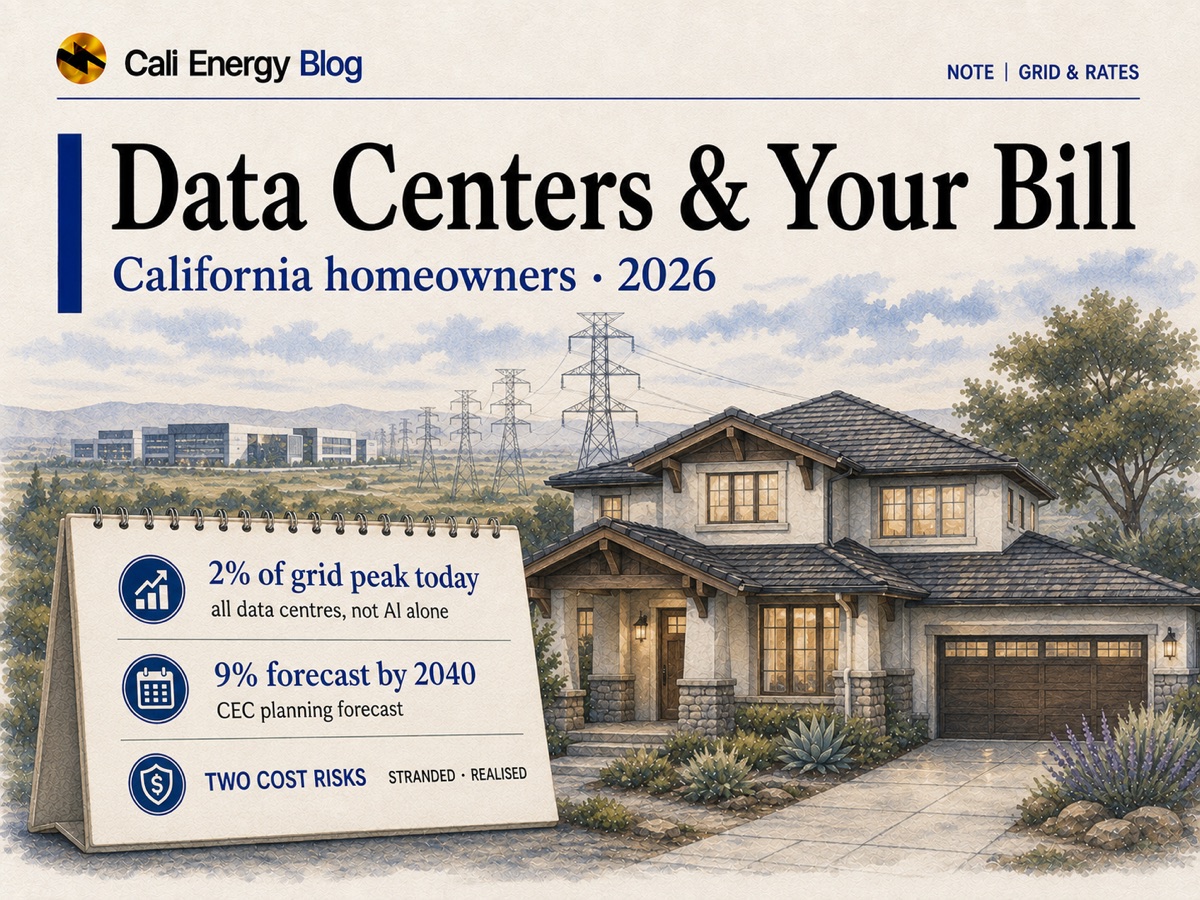
California’s energy regulator reports all data centers — not only AI facilities — at about 1,000 MW, or 2% of California ISO peak demand in early 2026, forecast to reach 9% by 2040. No published statewide analysis isolates a residential-bill increase attributable specifically to AI. What the data does show is where the cost risk sits — and in September 2026 California signed laws telling the CPUC to make data centers carry it.
Quick answer
Short answer: not measurably, not yet — but the risk is real, and it is about who pays for the grid, not about how much power the servers use. As of October 2026 no published statewide analysis has measured an AI-specific increase in California residential bills, and the CPUC does not name data centers among the drivers of the past decade’s rate increases. Upward pressure appears when grid investment made for large new loads ends up spread across existing customers — above all when a project is delayed or never gets built. In September 2026 California signed laws aimed at exactly that, but the CPUC has not yet written the rules.
- The CEC figure covers all data centers, not AI specifically. No published dataset separates AI workloads from the rest.
- About 1,000 MW, or 2% of California ISO peak demand, in early 2026, forecast to 4,500 MW / 9% by 2040.
- Data centers are not named among the primary drivers of the decade-long rate increases. The CPUC names wildfire costs, transmission and distribution investment, and rooftop solar incentives.
- That is not the same as zero effect. A share of peak demand is not a share of costs, and no published analysis quantifies the current bill impact either way.
- Two distinct cost risks exist: infrastructure built for projects that never materialize, and genuine new demand requiring generation and network investment.
- Most requests are in Northern California. Of 23,278 MW requested from utilities by December 2025, PG&E accounts for 14,747 MW; SCE for 4,623 MW, of which only 72 MW had signed agreements.
- New laws, rules still to come. SB 1168 and SB 886 were signed on September 21, 2026; the CPUC must now assess how data centers pay their share and set separate tariffs for them.
The question, answered line by line
Each row states what the published record supports as of October 2026.
| Question | What the published record shows | Answer |
|---|---|---|
| Are AI data centers raising California bills right now? | No statewide analysis isolates an AI-specific bill effect; the CPUC names wildfire costs, transmission and distribution investment, and rooftop solar incentives as the drivers of recent increases | Not measurably |
| Could they push rates up in future? | New large loads can require generation and network investment; if that cost is spread across all customers, existing ratepayers carry part of it | Yes — conditionally |
| Which risk is larger? | Infrastructure built for projects that are later delayed or cancelled leaves the cost without the offsetting load — and more than three-quarters of requested capacity is still applications or inquiries | Stranded cost, not consumption |
| How much of California’s peak demand is this? | All data centers together: about 1,000 MW, roughly 2% of California ISO peak demand in early 2026; forecast to 4,500 MW and about 9% by 2040 | 2% today, 9% forecast |
| Does the law now make developers pay their own way? | SB 1168 and SB 886, signed September 21, 2026, direct the CPUC to make data centers pay their share and to set separate data-center tariffs; the rules are not yet written, and PG&E’s large-load rule is still interim | Law passed, rules pending |
| Is Los Angeles a hotspot? | SCE reported 4,623 MW of requests but only 72 MW under signed agreements; LADWP is not among the utilities that reported to the CEC | Not so far |
| Can a household do anything about it? | Rooftop generation reduces the volume of grid electricity a household buys, which limits exposure to whatever the volumetric rate becomes | Partly — by using less grid supply |
What data centers actually draw today
Start with the number, because most coverage skips it.
The California Energy Commission puts current data-center load at about 1,000 megawatts, or 2 percent of the California Independent System Operator’s peak electricity demand. The CEC began folding data-center growth into its demand forecasts in 2024, using the applications developers actually submit to utilities, and the figures feed the Integrated Energy Policy Report.
| Period | Load | Share of CAISO peak |
|---|---|---|
| Early 2026 | ~1,000 MW | 2% |
| Forecast, 2040 | 4,500 MW | 9% |
Source: California Energy Commission — Data Centers, figures from the CEC Planning Forecast. Verified October 6, 2026.
Set those numbers against the bill history carefully. Residential rates at the three large investor-owned utilities rose 69% at PG&E, 97% at SDG&E and 101% at SCE between January 2016 and June 2026. The CPUC names the primary statewide drivers as wildfire mitigation and liability costs, transmission and distribution investment, and rooftop solar incentives. Data centers are not on that list.
But two cautions belong here, and most coverage skips both. A share of peak demand is not a share of costs — megawatts at peak do not translate directly into kilowatt-hours, revenue requirements or bill impact. And the CEC figure is for all data centers, a category that long predates the current AI build-out.
The honest position: published statewide data does not isolate a residential-bill increase attributable specifically to AI, and data centers are not identified as a primary driver of the decade-long increase — but their current bill effect has not been quantified either. Anyone asserting a precise number in either direction is going beyond the evidence.
Where the requests are, utility by utility
Requested capacity is not demand — but it shows where the grid is being asked to grow.
| Utility | Signed agreement | Application | Inquiry | Total |
|---|---|---|---|---|
| PG&E | 4,356 | 3,617 | 6,774 | 14,747 |
| SCE | 72 | 3,174 | 1,378 | 4,623 |
| Valley Electric (Nevada sites in CAISO) | 0 | 2,600 | 0 | 2,600 |
| Silicon Valley Power | 644 | 196 | 198 | 1,038 |
| SDG&E | 0 | 0 | 100 | 100 |
| Burbank | 0 | 0 | 100 | 100 |
| Palo Alto | 14 | 0 | 55 | 69 |
| Total | 5,086 | 9,587 | 8,604 | 23,278 |
Source: California Energy Commission — Supporting Document for the 2025 IEPR Forecast: data center methodology (April 2026), Table 1, utility data as of December 2025. LADWP did not provide data for this forecast.
Two things stand out. First, most requested capacity is not committed: only 5,086 MW — about 22% — has signed service agreements, and the CEC’s planning forecast counts only 70% of signed agreements, 33% of active applications and none of the inquiries (its high scenario for local grid planning uses 100%, 50% and 10%). That gap between requests and expected load is exactly where stranded-cost risk lives. Second, Southern California is a small part of it so far: SCE reported 4,623 MW of requests but just 72 MW under signed agreements, against 4,356 MW at PG&E. The CPUC’s Public Advocates Office singles out the South Bay, where transmission upgrades of more than $2 billion were approved largely for concentrated data-center and electrification load.
Why one facility matters more than 2% suggests
The share is small; the individual units are not. The CPUC’s Public Advocates Office notes that developers in California increasingly plan facilities with loads exceeding 50 to 100 megawatts — roughly the residential energy use of a city the size of Santa Rosa or Huntington Beach.
A single customer request the size of a mid-sized city does not slot into an existing grid. It triggers infrastructure:
- Individual interconnection projects run from a few million dollars to more than $100 million.
- In the South Bay, CAISO approved transmission upgrades costing more than $2 billion, largely to serve 2.5 gigawatts of concentrated data-center and electrification load growth between 2026 and 2039.
- CAISO has identified billions of dollars in transmission upgrades needed over the next decade.
Source: Public Advocates Office at the CPUC — How Will Data Center Growth Impact California Ratepayers? (October 27, 2025). Verified October 6, 2026.
Two cost risks, not one
Stranded infrastructure is the one that gets least attention. It is not the only one.
Here is the mechanism, in the Public Advocates Office’s own words. Under current FERC rules, transmission costs are “socialized across all ratepayers within the CAISO territory.” If data-center projects are cancelled or fail to reach the load they promised, “the significant costs that utilities incurred to serve these data centers will be passed on to existing ratepayers.”
Read that carefully, because it inverts the usual complaint. The danger is not a data center that runs at full tilt and buys a lot of electricity — that customer contributes revenue. The danger is the grid getting built for a facility that arrives late, arrives smaller, or never arrives at all. The steel is in the ground either way, and the bill for it is shared.
This is also why the 2% figure is not reassuring on its own: the cost lands when the infrastructure is authorized, not when the load shows up.
The second risk is the opposite case. A data center that does arrive and runs at full load is real demand — it can require new generation, transmission and distribution investment of its own. Both paths can raise costs; they simply fail in different ways. Presenting stranded cost as the only risk would be as one-sided as blaming AI for last decade’s bills.
What California has and has not decided
New law. On September 21, 2026, Governor Newsom signed SB 1168 (McNerney), which directs the CPUC to assess ways to make data centers pay their fair share of transmission and distribution upgrades, pay for their share of load increases, and relieve rate pressure on residential customers. It takes effect January 1, 2027. The same day he signed SB 886 (Padilla and McNerney), which requires the CPUC to establish separate tariffs for data centers (Senator McNerney’s office). The Governor’s office presented them as part of a package of data-center laws covering electricity, water and land use.
Not yet decided: the numbers. Neither law sets a rate, a threshold or a charge; those come out of CPUC proceedings that have not concluded. Until then, the cost-allocation rules that applied before still govern projects already in the queue.
PG&E’s large-load rule is interim. In July 2025 the CPUC approved an interim Electric Rule 30 for transmission-level customers such as data centers, available only to applicants that pay for the needed transmission work up front; how any refunds are allocated was left to a later decision (CPUC). The Public Advocates Office had called PG&E’s approach “a step forward” that “lacks other protections that would effectively mitigate financial risks,” asking for minimum demand charges, early-termination fees and planning that reassesses transmission when projects stall (Public Advocates Office).
Status checked October 6, 2026. The Legislature’s bill pages could not be read directly from our tools this time; signature dates are from the author’s office release.
What this means for your bill this year
Nobody has published a figure, and we are not going to invent one. Data centers are not named among the CPUC’s primary drivers of the past decade’s increases, and no statewide analysis isolates a residential-bill effect attributable to them — in either direction. That is the accurate answer, and it is less satisfying than the ones circulating.
What is worth watching is the next few years of transmission spending and who is made to carry it. That now gets decided in the CPUC proceedings that SB 1168 and SB 886 set in motion — not in headlines about AI. To see what is actually queued up in the two largest territories, our tracker of SCE, PG&E and SDG&E rate filings follows them quarter by quarter.
What this page cannot determine
- Whether any specific project will be built. Announced data centers are frequently revised, delayed or cancelled; that uncertainty is the entire point of the stranded-cost problem.
- Your future rate. Rates change through regulatory decisions. Forecasts here are the CEC’s load projections, not price predictions.
- How much of a future increase would be attributable to data centers. Transmission serves many loads at once; separating the share is a regulatory question, not an arithmetic one.
- What the CPUC will set under SB 1168 and SB 886. We report status and date, nothing more.
Frequently asked
Are AI data centers raising my electricity bill in California right now?
No published statewide analysis isolates that. The CEC reports all data centers at about 1,000 MW, or 2% of California ISO peak demand, in early 2026 — a figure that does not separate AI workloads. Data centers are not named among the CPUC’s primary drivers of the 2016–2026 rate increases, which are wildfire costs, transmission and distribution investment, and rooftop solar incentives. But a share of peak demand is not a share of costs, so their current bill effect has not been quantified in either direction.
How much electricity do California data centers use?
About 1,000 megawatts, or 2 percent of California ISO peak demand, as of early 2026, per the California Energy Commission. The CEC forecasts growth to 4,500 MW, or 9 percent of peak, by 2040.
Is Los Angeles a data center hotspot?
Not so far. Of 23,278 MW of data-center capacity requested from California utilities by December 2025, SCE reported 4,623 MW — but only 72 MW under signed service agreements, against 4,356 MW at PG&E. LADWP was not among the utilities that reported to the CEC for its 2025 forecast.
So what is the actual risk to ratepayers?
Two risks, not one. First, stranded cost: under current FERC rules transmission costs are socialized across all ratepayers in the CAISO territory, and the Public Advocates Office warns that if projects are cancelled or underperform, costs already incurred pass to existing ratepayers. Second, realized demand: a facility that does arrive can require new generation and network investment. Both can raise costs.
How big is one data center compared with a town?
California developers increasingly plan facilities exceeding 50 to 100 MW — roughly the residential energy use of a city the size of Santa Rosa or Huntington Beach, according to the Public Advocates Office. Individual interconnection projects range from a few million dollars to more than $100 million.
Has California passed a law making data centers pay their share?
Yes, in principle. Governor Newsom signed SB 1168 on September 21, 2026; it directs the CPUC to assess how data centers pay their fair share of transmission and distribution upgrades and load growth while relieving pressure on residential rates, and takes effect January 1, 2027. SB 886, signed the same day, requires separate data-center tariffs. The actual charges will come from CPUC proceedings that have not concluded.
Does rooftop solar reduce this risk?
Distributed generation and storage reduce load at the point of use, which is generally helpful for local distribution constraints. But the transmission investments discussed here are driven by large concentrated loads and regional planning, so it would be overstating it to present home solar as a solution to that specific problem.
Related reading
Sources & methodology
Figures on this page come from the primary sources below and, where noted, from Cali Energy calculations using the stated assumptions. Rates, incentives, and program terms change; each was verified October 6, 2026.
- California Energy Commission — Data Centers
- California Energy Commission — Supporting Document for the 2025 IEPR Forecast: data center methodology (April 2026)
- CPUC Public Advocates Office — How Will Data Center Growth Impact California Ratepayers? (Oct 2025)
- Senator Jerry McNerney — Newsom signs SB 1168 (September 21, 2026)
- Office of the Governor — data center laws signed (September 21, 2026)
- CPUC — interim Electric Rule 30 for transmission-level customers (July 24, 2025)
- CPUC Public Advocates Office — Q2 2026 Electric Rates Report (PDF)
About this reference
Cali Energy is a licensed California contractor (CSLB #1032379) in Northridge. We publish this page as a reference and date it to the day each figure was checked against its source.
Prepared by Cali Energy, October 6, 2026. This article is for general educational purposes only and is not legal, tax, financial, engineering, or utility advice. Rates, incentives, codes, permit requirements, equipment specifications, prices, and program terms may change; figures and timelines are estimates, not guarantees. Confirm current requirements with the applicable utility, AHJ, program administrator, manufacturer, or a licensed professional. See our Content Disclaimer. Cali Energy · 19201 Parthenia St, Unit E, Northridge, CA 91324 · CSLB #1032379 (B, C-10, C-39)
